

Diode vs Alexandrite Laser Hair Removal: Which Is Better?
An honest comparison by skin type, hair colour and comfort – and why we chose a diode laser for our Budapest clinic.

In the diode vs alexandrite laser hair removal question, neither laser is simply “better”. Alexandrite lasers (755 nm) tend to excel on light skin with dark or finer hair, while diode lasers are usually the more versatile choice across skin types, including olive and darker skin, provided the settings are right. The best laser for you depends on your skin type, your hair colour and thickness, the area being treated – and on who is operating the device.
Both are proven, widely used technologies. Below we explain how each one works, compare them side by side, look briefly at Nd:YAG and IPL, and explain why we chose a diode laser for our clinic in Budapest – without pretending the other options don’t work.
How laser hair removal works – and why wavelength matters
Every hair removal laser relies on the same principle, called selective photothermolysis. The laser emits light at a specific wavelength, which is absorbed by melanin – the pigment in the hair shaft and follicle. The light turns into heat, and that heat weakens the follicle so it produces less hair over time.
The challenge is that your skin contains melanin too. The more pigment there is in the outer layer of your skin, the more of the laser’s energy it can absorb on the way down to the follicle – and that is where the risk of burns or pigment changes comes from. This is why wavelength matters so much:
- Shorter wavelengths (such as 755 nm) are absorbed very strongly by melanin. That makes them powerful on dark hair, but also less forgiving on skin that has a lot of pigment of its own.
- Longer wavelengths (around 800–810 nm and above) are absorbed somewhat less by melanin and reach deeper into the skin, so it is easier to spare the skin’s surface while still heating the follicle.
One more thing is true for every laser: it can only affect hairs that are in their active growth (anagen) phase at the time of treatment. Hair grows in cycles and only a portion of it is in this phase at any moment, so you always need a series of sessions – whichever device is used.
What is an alexandrite laser?
The alexandrite laser works at a wavelength of 755 nm. Its high melanin absorption is its big strength: on light skin with dark hair it delivers energy very efficiently to the follicle, and it is widely regarded as particularly effective on finer dark hair that some other lasers find harder to target.
Where alexandrite shines
- Fair to light-olive skin (roughly Fitzpatrick skin types I–III, in some cases IV)
- Dark brown or black hair, including finer hair – for example on the face or arms
- People whose hair colour contrasts clearly with their skin
Its limitations
The same strong melanin absorption that makes alexandrite effective also makes it less suitable for darker skin types and for tanned skin. Because more energy is absorbed by the skin’s surface, the risk of burns, blistering and temporary pigment changes is higher. A well-trained practitioner will either work very conservatively or recommend a different wavelength for these clients.
None of this makes alexandrite a “worse” laser. It is a well-established technology – it is simply most at home on a particular group of skin and hair types.
What is a diode laser?
Diode lasers commonly operate at around 800–810 nm, and some newer devices combine several wavelengths. Compared with 755 nm, this light penetrates a little deeper and is absorbed somewhat less by the melanin in the skin’s surface. In practice, this gives the operator more room to treat a wider range of skin types – including olive, brown and darker skin – with appropriately adjusted settings.
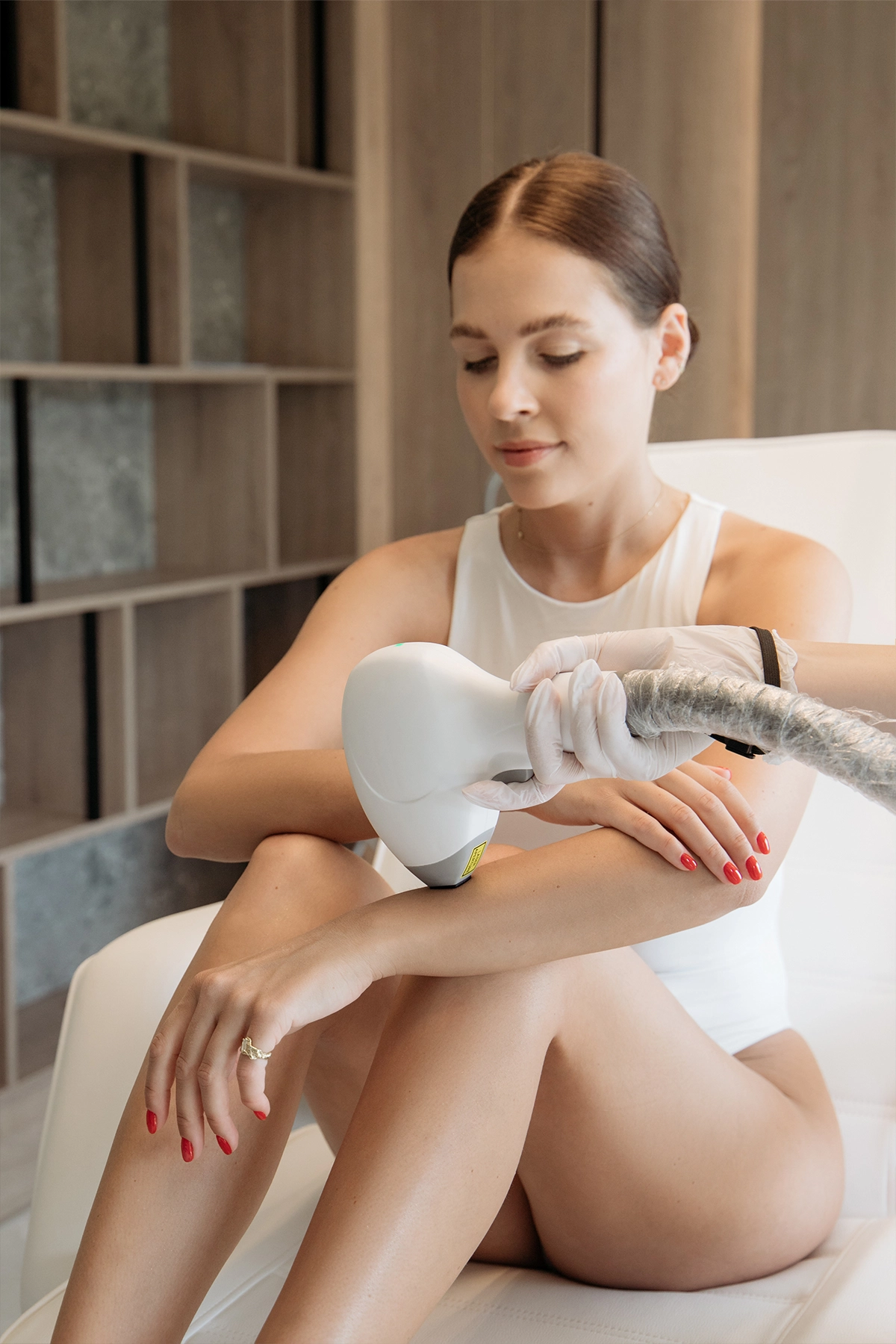
Diode laser hair removal is also often paired with contact cooling: the handpiece itself is chilled and cools the skin while the laser is working. This protects the outer layer of the skin and makes treatment noticeably more comfortable for most people.
Where diode shines
- A broad range of skin types, from fair to darker skin, when settings are adjusted to the individual
- Medium to coarse dark hair – for example the bikini line, underarms and legs, or a man’s back and chest
- Comfort, where the device has a cooled handpiece
Its limitations
Like every laser, a diode needs pigment in the hair to work. On very fine or lighter hair, results can come more slowly, and some practitioners consider a shorter wavelength such as alexandrite to have an edge on very fine dark hair on fair skin. Diode devices also vary considerably between manufacturers, so the specific machine and how it is set up matter as much as the label “diode”.
Diode vs alexandrite laser hair removal: side-by-side comparison
The table below summarises the typical differences. Treat it as a general guide: individual devices, settings and the operator’s experience can shift the picture.
| Feature | Alexandrite laser | Diode laser |
|---|---|---|
| Wavelength | 755 nm | Typically around 800–810 nm (some devices combine wavelengths) |
| Best-suited skin types | Fair to light-olive skin (roughly types I–III, sometimes IV) | A broad range, including darker skin, with settings adjusted to each person |
| Hair types | Dark hair, including finer hair | Dark medium-to-coarse hair; fine hair may respond more slowly |
| Comfort and cooling | Depends on the device; cold-air or cryogen-spray cooling is common | Often contact cooling through a chilled handpiece |
| Tanned skin | Generally not recommended; higher risk of burns and pigment change | Needs caution and adjusted settings; recent sun exposure should still be avoided |
| Typical use | Light skin with dark or fine hair, e.g. face and arms | Most body areas across many skin types, e.g. legs, bikini, underarms, back |
What the table cannot show is the most important factor of all: the person holding the handpiece. A careful skin assessment, a test patch and settings tailored to your skin and hair often matter more than the choice between two good technologies.
Where Nd:YAG and IPL fit in
Two other technologies often come up when you compare clinics:
- Nd:YAG (1064 nm) has the longest wavelength of the common hair removal lasers and the lowest melanin absorption. That makes it a frequent choice for the darkest skin types, but it is generally less effective on fine or lighter hair.
- IPL (intense pulsed light) is not a laser at all. It uses a filtered, broad-spectrum flash of light rather than a single precise wavelength. We explain the differences in detail in our article on laser vs IPL hair removal.
Put simply, the three lasers sit on a spectrum: alexandrite has the strongest melanin absorption, Nd:YAG is the gentlest on skin pigment, and diode sits in between. That middle position is a large part of why diode is often described as the all-rounder.
Which laser is best for you? A guide by skin and hair type
Fair skin with dark hair
This is the easiest combination for any laser. Both alexandrite and diode can work very well here, and alexandrite may have a slight advantage on very fine dark hair.
Olive or medium skin
Both technologies can be used, but the margin for error is smaller at 755 nm. A diode laser with good cooling is often a comfortable, safe option, with settings chosen after a test patch.
Brown or dark skin
Diode (with conservative, individually adjusted settings) or Nd:YAG is usually preferred over alexandrite. Read more in our guide to laser hair removal for different skin types and safety.
Coarse hair on larger areas
Thick, dark hair on the legs, bikini line, back or chest generally responds well to diode lasers. If you are a man considering your back, chest or beard line, you will find more detail in our article on laser hair removal for men in Budapest.
Recently tanned skin
No laser is a good idea on freshly tanned skin. Let the tan fade first, and avoid sun, solarium and self-tan for two weeks before and after each session.
Why Dunaderm chose a diode laser
At Dunaderm we use the Elysion Pro diode laser, which has a built-in cooled handpiece that cools the skin throughout the treatment. We chose a diode because of who we treat and what we value – not because we think alexandrite is a poor technology:
- Versatility across skin types. Budapest is home to people with many different skin tones and hair types. The Elysion Pro can be used on all skin types, including darker skin, with the settings adjusted to each person; suitability is always confirmed at the free consultation and with a test patch.
- Comfort. Thanks to the cooled handpiece, most clients feel only mild warmth or tingling, and no anaesthetic cream is needed. If you do find your first session painful, our Comfort Guarantee refunds the fee for that first session. More on this in our article on pain-free laser hair removal.
- Year-round treatment. With strict sun protection – no sun, solarium or self-tan for two weeks before and after, plus a high-SPF sunscreen – treatment can continue in summer, so you don’t have to pause your course for months.
- Consistency. Laser treatments are performed by cosmetologist Lia Naszádi, who has 12 years’ experience, and aesthetician Szandra Simon. Settings are matched to your skin and hair at every session.
Before any course begins, you have a free consultation where we assess your skin and hair, check your health and medications, and plan your treatment, followed by a free test patch on a small area. All treatable areas and prices are listed on our laser hair removal in Budapest page.
What no laser can change
Whichever technology you choose, some things are decided by biology rather than by the device:
- White, grey and very light blond hair has little or no pigment for the laser to target, so it responds poorly or not at all to any laser. Red hair usually responds poorly too. A good clinic will tell you this honestly at the consultation.
- You will need several sessions. Because only actively growing hairs can be treated, a course typically involves 6–10 sessions, 4–8 weeks apart depending on the area. See our article on how many laser hair removal sessions you need.
- Hormones play a role. Hormonally influenced areas – for example with PCOS, or a man’s face and neck – often need more sessions, and occasional maintenance sessions may be needed later.
- Results vary. The aim is long-term, permanent hair reduction, and how far that goes differs from person to person. Nobody can honestly guarantee a specific outcome.
Side effects are possible with every laser. Temporary redness and slight swelling around the follicles are common and short-lived. Less commonly, blistering, burns or temporary lightening or darkening of the skin can occur – more likely on tanned or darker skin or with unsuitable settings. Paradoxical hair growth is rare. Eye protection is always used, and contraindications such as pregnancy, certain medications or skin disease in the treatment area are checked before you start.
How to choose: questions to ask a clinic
If you are looking for the best laser for hair removal in Budapest, rather than asking “which laser is best?”, ask questions that reveal whether a clinic will use its laser well on your skin:
- Which laser do you use, and why does it suit my skin type and hair colour?
- Who will perform my treatment, and how much experience do they have?
- Will you assess my skin type and medical history before we start?
- Do you offer a test patch?
- How is my skin cooled during treatment, and will I need numbing cream?
- What happens if I get a tan or go on holiday mid-course?
- How many sessions are realistic for my area, and might I need maintenance?
- Is the price per session or per package, and what exactly is included?
A clinic that answers these clearly – including telling you when laser is not the right choice for you – is usually a better sign than any brand name. For a breakdown of costs per area and package, read our laser hair removal prices guide for Budapest.
Not sure which laser suits your skin?
The quickest way to a clear answer is to have your skin and hair assessed in person. At Dunaderm your consultation and test patch are free, and consultations and treatments are available in English. Prices start at 8.000 Ft per session for small areas such as the upper lip, and instalment payment is available for packages over 100.000 Ft.
Current offer (until 31 December 2026): 8-session single-area packages are 30% off, and multi-area packages are 40% off.
Find us at 1138 Budapest, Hajóépítő sétány 4. (Marina Part, near Duna Plaza), building D, 3rd floor, or call +36 30 400 81 80 (Mon–Fri 08:00–20:00, Sat 10:00–14:00). You can also book your free consultation online.